
After over 9 years treating hundreds of orthodontic cases—from mild crowding to complex bite corrections—I can tell you something that might surprise you: the “Invisalign vs. braces” debate isn’t about which is better. It’s about which is right for you.
I’ve seen patients walk in asking specifically for Invisalign, only to discover that braces would give them a dramatically better result. I’ve also seen the opposite—patients terrified of “metal mouth” who were actually perfect candidates for clear aligners.
Let me give you the honest breakdown that most articles skip over.
The Quick Answer (If You’re in a Hurry)
Choose clear aligners (Invisalign) if:
- Your case is mild to moderate (spacing, minor crowding, slight bite issues)
- You can commit to wearing them 20-22 hours daily
- Aesthetics during treatment matter to you
- You want easier oral hygiene
Choose braces if:
- You have complex issues (severe crowding, significant bite problems, tooth rotations)
- You might forget to wear removable aligners
- You want the most cost-effective option
- Your orthodontist specifically recommends them for your case
Now, let’s get into the details.
Invisalign vs. Braces: What Are We Actually Comparing

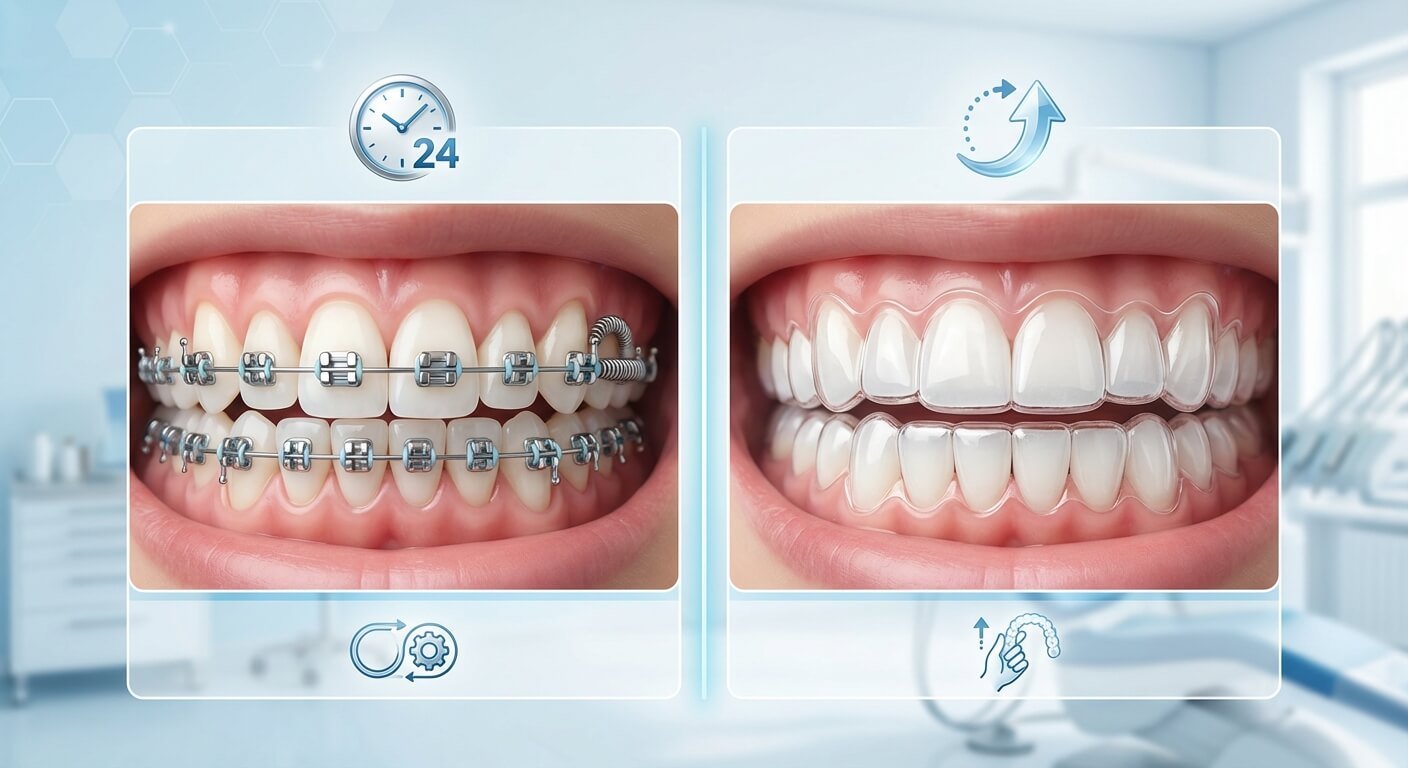
Traditional Braces
Metal or ceramic brackets bonded to your teeth, connected by wires. They work 24/7 because you can’t remove them, which is both their greatest advantage and biggest drawback.
At Professors Dental Clinic, we use high-quality brackets and modern techniques that make today’s braces significantly more comfortable and efficient than what you might remember from years ago.
Clear Aligners (Invisalign)
A series of custom-made transparent plastic trays that gradually shift your teeth. You change to a new set every 1-2 weeks. They’re nearly invisible—but only if you actually wear them.
Effectiveness: What the Research Actually Shows
Here’s what most marketing materials won’t tell you: approximately 88% of cases treated with Invisalign and 90% of cases treated with conventional braces resulted in effective corrections.
That 2% difference? Clinically insignificant for most patients. Both work.
But here’s where it gets interesting: the Invisalign group had a slightly higher percentage of relapse cases (12%) compared to the traditional braces group (10%).
What does this mean for you? Clear aligners can achieve excellent results, but long-term stability may favor traditional braces—especially for complex movements.
Where Braces Win
Traditional metal braces are ideal for correcting a wide range of orthodontic problems, including severe crowding, large gaps, and bite misalignments. They offer precise control over tooth movement, including vertical shifts and rotation, which can be challenging with clear aligners.
In my practice, I often recommend braces for:
- Severe bite problems (overbites, underbites, crossbites)
- Significant tooth rotations (especially premolars and canines)
- Cases requiring tooth extraction
- Young patients who might struggle with aligner compliance
Where Aligners Excel
Clear aligners are perfect for:
- Mild to moderate crowding or spacing
- Adults who need discretion for professional settings
- Patients with excellent hygiene habits
- Those wanting easier maintenance during treatment
Confused by conflicting advice online? Get a straight answer from an actual orthodontist. WhatsApp us your question today.
Treatment Time: The Real Numbers
Clinical research shows that the mean treatment time for Invisalign was much shorter (18 months) than for conventional braces (24 months).
But here’s the catch: that statistic applies to similar cases. When you compare apples to apples:
The braces group finished treatment significantly earlier (0.4 years) than the aligner group when treating patients with similar simple malocclusions.
My honest assessment:
- Simple cases: 6-12 months with either option
- Moderate cases: 12-18 months (aligners may be slightly faster with perfect compliance)
- Complex cases: 18-24+ months (braces often more efficient)
The Lifestyle Factor (This Matters More Than You Think)
Food Restrictions
Braces: You’ll need to avoid hard, sticky, and crunchy foods. No popcorn, no hard candies, careful with apples—you know the list.
Aligners: No restrictions! Simply remove them to eat whatever you want. Just brush before putting them back.
Oral Hygiene
Braces: Require careful brushing around brackets and threading floss under wires. It takes more time, and plaque buildup is a real concern.
Aligners: Brush and floss normally. Clean your aligners with a gentle soak. Much simpler.
Compliance
This is where I’ve seen the most treatment failures with aligners. Invisalign must be worn 20–22 hours a day to be effective. Skipping wear time can delay progress.
If you’re the type to lose things, forget tasks, or lack discipline with health routines—braces might actually be your better option. Since braces are fixed to the teeth, they work continuously without relying on patient compliance.
Pain and Comfort
Both options cause discomfort—you’re moving teeth through bone, after all.
Braces: Initial soreness for 3-5 days after placement and adjustments. Brackets can irritate cheeks and lips, especially early on. We provide orthodontic wax for this.
Aligners: Pressure sensation when switching to new trays. Generally reported as more comfortable since there are no wires or brackets to cause irritation.
My Patient Selection Process
At Professors Dental Clinic, I never recommend a treatment based solely on patient preference. Here’s my evaluation process:
- Comprehensive examination – Including digital X-rays and 3D scans
- Case complexity assessment – Measuring crowding, bite relationships, and required tooth movements
- Lifestyle evaluation – Understanding your daily routine, profession, and compliance likelihood
- Treatment simulation – Showing you projected outcomes with digital modeling
- Honest recommendation – Sometimes that means telling you aligners won’t work for your case
About My Orthodontic Background

I believe you should know who’s giving you advice. I’m a certified specialist orthodontist and dentofacial orthopedist with:
- Master of Science in Orthodontics from Alexandria University
- PhD Researcher at Alexandria University’s Faculty of Dentistry
- Fellow of the World Federation of Orthodontists (WFO)
- Member of the American Association of Orthodontists (AAO)
- Member of the European Orthodontic Society
I’ve presented research internationally—including at the World Federation of Orthodontists Congress in Brazil (where I received the Best Clinical Case Award among 7,000+ participants from over 100 countries). I’m also a peer reviewer for respected academic journals, including the American Journal of Orthodontics and Dentofacial Orthopedics.
Why does this matter? Because the difference between a good and excellent orthodontic result often comes down to diagnosis, treatment planning, and the small details that only experience teaches you.
Have a specific question about your teeth? WhatsApp us now—Dr. Khalil personally reviews every inquiry.
Frequently Asked Questions
Can I switch from braces to Invisalign (or vice versa)?
Yes! Some patients start with braces for complex movements, then transition to aligners for finishing touches. Others discover mid-treatment that they can’t maintain aligner compliance and switch to braces. A flexible orthodontist can adjust your plan as needed.
Are results permanent?
Only with proper retention. After any orthodontic treatment, you’ll need retainers to maintain your results. Teeth naturally want to shift back—this is true regardless of whether you had braces or aligners.
📌 Readers Also Liked: before and after braces cases from our clinic
Which option is faster?
It depends entirely on your case. Most cases range from 6-18 months, depending on complexity—and this applies to both treatment types when properly matched to the right patient.
Do aligners hurt less than braces?
Aligners generally cause less irritation since there are no brackets or wires. However, both options involve moving teeth, which causes some discomfort regardless of the system used.
Can aligners fix my overbite?
Mild to moderate overbites—often yes. Severe skeletal overbites—usually braces are more effective, sometimes combined with other appliances. This is exactly why an in-person evaluation is essential.
The Bottom Line
Stop thinking about “Invisalign vs. braces” as a competition. Think about it as selecting the right tool for the job.
A skilled carpenter doesn’t ask “hammer or screwdriver?” without knowing the task. Similarly, your orthodontic treatment should be selected based on:
- What your teeth actually need
- What you can realistically maintain
- What will give you the best long-term result
At Professors Dental Clinic, we provide honest assessments. If aligners will work beautifully for you, I’ll recommend them enthusiastically. If braces will give you a significantly better outcome, I’ll tell you that too—even if aligners are what you came in asking for.
Your smile is too important for a one-size-fits-all answer.
Don’t guess—ask an expert. WhatsApp Dr. Khalil’s team now and get clarity on your orthodontic options.
Ready to Find Out Which Option Is Right for You?
The only way to know for certain whether braces or aligners will serve you better is a professional evaluation. At Professors Dental Clinic, consultations include digital X-rays, examination, and a clear treatment plan recommendation.

Master of Science in Orthodontics from Alexandria University, PhD Researcher, and Fellow of the World Federation of Orthodontists. Expert in clear aligners and metal braces with advanced international training.